In ancient Greek tragedy, the audience knows the fate of the hero even if it ignores parts of the plot. Self-destruction awaits our protagonist at the end, and their actions, imbued with ignorance and powerlessness, enact and accelerate their moira (fate).
The audience is both gifted and cursed with this knowledge, and suffers for the protagonist, who knows less than they do. When the tragic moment finally arrives, and the hero meets their moira, this is the moment of purification or catharsis.
Aristotle writes, at the very definition of tragedy:
The catharsis is the collective expression of what was already present, and its manifestation is its negation as an individual burden. It is the moment where the audience can finally unite with the hero, and stop witholding things from them. The salvation of the tragic hero does not come from a glorious victory, but from the fact that the end of every tragedy is the beginning of a new one. In the Oresteia, for example, the murder of Agamemnon sets the stage for the next play, where Orestes returns to avenge his father. Each episode in the drama, therefore, is a self-contained reality and part of a connected history.
The times we live in are, I think, akin to a tragedy with a not-yet catharsis. The fear and pity we feel—for our historical moment, for the planet, for each other, and for ourselves—is either suffered individually or exhausted in trivial conversations.We lack, to speak metaphorically, a magnificent theater, which through its design and acoustics would be able to concentrate and channel our fears into a powerful force.
Until we experience the liberating moment of self-awareness of the end of our historical period, not individually and cognitively, but collectively and affectively, we won’t be protagonists in a tragedy, but in something worse. And as long as this drama is not ending, the new cannot begin.
I told you to complete the self-evaluation you wrote “low,” and I didn’t stop you.
No child should be allowed to do this to themselves.
Can I say I didn’t know? That I come from afar? The image of you stamped with a mark from your early years, carrying this on your shoulders and running behind it — this image is alien to me.
Expected grade, above target, below target. Vol’s too high, low conviction, small size. The sorcery of swaps and assets. The future colonised. A liability. Class system in a classroom.
I saw you the other day at the skate park, and you looked different. You waved at me and told me to watch.
You took your skate and did spins and turns. And the question I have for you is:
How does the world look when you spin?
The next day I told you I understand why you can’t stand still. And I promised you we ‘ll finish your wooden toy, and you will take it home.
When the Doomsday Clock struck midnight, the planet was transformed into an amorphous blob.
The humans who survived tried to repair the systems that once modelled climate change, even though the climate had changed beyond modelling.
A member of the crew, who had heard about these systems but had spent their life working in the mines, came up with an idea:
“Why don’t we replace the giant clock with a giant thermometer? We’ll work in one way when the temperature of the planet goes up, and we’ll work in another way when the temperature of the planet goes down.
No profits, no money, nothing. We will check the thermometer every dozen years, and that’s it”.
And their idea made sense, and they all lived happily ever after.
The environmental crisis and the crisis of work are one and the same.
Humans of late capitalism are impotent in the thermodynamic sense: they are unable to turn heat into work. As natural beings, humans are subjected to the objective powers of nature: hunger, cold, finitude. They therefore suffer (Marx: To be sensuous is to suffer). As human-natural beings, however, Marx notes in the Manuscripts, humans can feel their suffering, and convert suffering into passion (πάθος into πάθος, in greek they are one and the same).
As Scott notes, this metabolic ability is disrupted and mutated under capital, which reserves all passion for itself (Scott 2020). From the perspective of social thermodynamics, humans suffer, but cannot feel their suffering. They therefore cannot convert suffering into passion, nor passion into labour. Labour is not the mediation and objectification of individual and collective passions and needs, but coerced and alienating activity, performed under and resulting in the dissemination of mass apatheia.
Therefore: the disequilibrium and gradual collapse of natural systems owes itself to a total increase in entropy, but only because humans are failing to absorb, metabolise, and direct energy into sustainable patterns of motion. The energetic excess is returned back to nature and perceived as extreme phenomena; it is only nature screaming and shouting to us.
Lord Kelvin’s prophecy of the heat death of the universe is coming true, but only half. Instead of the dissipation of energy, the natural half has energy that does not know what to do with it, and the social half does not know what to do without its energy. The wildfire and the zombie are two sides of the same coin, and they will keep confronting each other until they become one and transcend both states.
Scott, R. (2020) ‘Suffering and the feeling of suffering in Marx’s Capital’, Textual Practice, 36(1), pp. 76–93. doi: 10.1080/0950236X.2020.1786720.
Working class is a trembling house We are trying to support it as we are looking for the egress On the way, we pick up the things of value to us: The history, the machines, the strike, the camaraderie.
But once outside, we realise that capital has been the architect and landlord We use the tools to give the final blow And with the ruins we build something we cannot name yet.
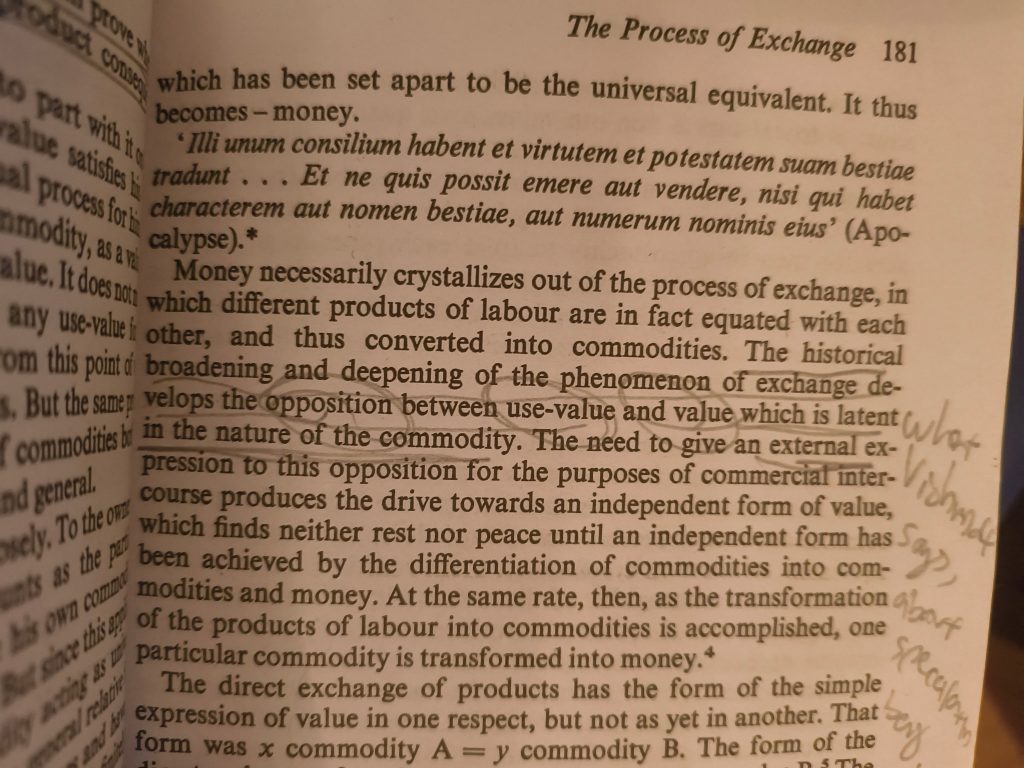
Let’s see what Marx writes on the relation between money and commodity in the second chapter of Capital:
What we have learnt is this:
1. “Money necessarily crystallises out of the process of exchange”. This is because, as Marx has earlier analysed in the first chapter of Capital, and Alfred Sohn-Rethel beautifully elaborated in his work Manual and Intellectual Labour, commodity exchange is first a praxis, that then becomes thought. This goes back to Marx’s materialist understanding of the movement of things, in which commodities actually move and change hands, training and inhabiting our muscles and senses in specific ways. This process is then echoed and justified in the mind retroactively — not least because we depend on it for our survival, and its justification in capitalism means the justification of our existence.
2. “Money is the external expression of the opposition between use value and value”. Or, in broader terms, the opposition between action and meaning, the work put into the object and the social desirability of this object. Money, in a Hegelian fashion, resolves this opposition by abstracting from this dialectic as a third entity that controls and subsumes both.
3. “Once the transformation of the products of labour is accomplished (in other words, in the historical era of industrial capitalism and onwards), one particular commodity is transformed into money” 1. As a social system, Capital can abstract from the material world and appear in an insubstantial form. As a human-natural system, however, it is linked by an umbilical cord to Earth and its substances. For centuries this substance has been gold. For Marx, the point to the matter is not that Capital is linked to the Earth or not, but that, in the eyes of Capital, the form of this connection doesn’t matter. The universal mediator can be linen, gold, data, whatever. It matters, however, to us as humans, and as nature.
On page 163, Marx writes: “The only difficulty in the concept of the money form is that of grasping the universal equivalent form and hence the general form of value as such.” Marx here refers to the analysis that precedes this passage, in which he has used the simple elements of coat and linen to introduce the relation of exchange in its simplest form; then, his analysis proceeds by positing linen as the universal equivalent to which every other commodity can refer to; then replacing linen with gold as the common denominator of all values; and finally, once all exchange is expressed in a single unit qualitatively, the amounts of gold and of the other commodities are quantitatively expressed in money — a gesture that hides gold from plain sight, and makes its social form powerful and omnipresent, while its physical form remains rare and hard to reach (more on the relationship between physical scarcity and social abundance in the future).
What Marx highlights, and keeps repeating throughout, is that this process of commodity formation through the praxis of exchange escapes the analysis of the political economist, who does not relate money and value to commodities, and takes the result of this process as the point of departure of their thinking. Instead of thinking insightfully, as Marx does, and seeing through the veil of money to the commodity, and through the veil of the commodity to the activity of humans and nature, the political economist thinks in the abstract, departing from money and therefore re-establishing it as a transcendental category of life, whereas it is only a category of capitalist life.
Marx refers to the modern political economists of his time, but the post-modern political economists of our times commit the same error. See, for example, the analysis of Yanis Varoufakis and his idea of Technofeudalism. One of the greatest storyteller of the crises of our times, Varoufakis excels when explaining the collapse of Bretton Woods, which – in one way, but not in another – untethered money from gold reserves and therefore from the material substratum of physical production. But his analysis has not yet made the connection between value and the commodity form, and it therefore reaffirms the market as something to be defended from the ‘tech overlords’ and regulated better. This shines through in Varoufakis’ utopian stories towards the end of the book, where his protagonist keeps buying and selling commodities, with UBI being summoned as a golden bullet and motor of production and exchange.
The affirmation of the market presupposes and re-affirms the commodity form. One mechanism through which this happens is the substitution of the commodity, now considered an obsolete or, in any case, less relevant form, with the asset. Lisa Adkins, one of our most prominent analysts of financialised capitalism, quickly eschews the commodity form in favour of the asset form, without performing the analysis that Marx founds all his mature work upon (see, for example, Adkins et al 2021).
It is, however, precisely because of Marx’s analysis that we can understand that once the dialectic between activity and meaning has been congealed in the commodity form, and expressed externally in money, there is nothing stopping this process repeating itself, and value being externally expressed again in higher levels of abstraction 2. Marx did not describe the commodity as a static thing to be simply overcome by the next one. Instead, he gave us the insights into a process where anything — even and especially commodities — can be further commodified and exploited. For a commodity, as Marx notes in the above passage, will find neither rest nor peace until it is externally expressed into money. As this process deepens and expands, Marx writes in the third chapter of volume 1 of Capital, it results in the enthronement of money as the universal commodity. Money is sold and bought, not necessarily in this order, but through every possible and impossible formulation of time–space.
Rushing to produce an intellectual innovation, and here they are little different from the innovators of Silicon Valley whom they criticize, the contemporary political economist obscures the continuities of the relation of exchange, which precedes capitalism and is as old as history. And, unless we act, they still have a long way to travel.
Another determination of financial capitalism, based on the analysis of Yanis Varoufakis, Jodi Dean, and others, is the role of profit. For them, profits are no longer re-invested into production, but accumulated in tax havens and assets, depriving the market of the liquidity required to reproduce itself, forcing it into starvation. It is true that, as Marina Vishmidt notes (2018 p.54), by speculating on assets, financial capitalism has bypassed the problem of making goods that have to be sold in the market. To use, however, the change in the direction of profit to call for a new historical epoch (Technofeudalism for Varoufakis, Neo-feudalism for Dean) is a risky intellectual act. The main reason being that capital always relied on profit to conceal the fact that labour is the source of wealth, and, subsequently, to make us think from the standpoint of profit, rather than the standpoint of the worker. This is beautifully articulated in the amazing – and free– little book by Derek Ford, Teaching the Actuality of Revolution, and I am citing his passage in length:
Let’s highlight this from the third Volume of Capital, cited above: “Disguised as profit, surplus value [in other words, worker exploitation and value extraction] actually denies its origin”. Derek, like Marx, is theorising capitalism from the standpoint of, and for the benefit of, workers – not drawing from the products of our labour such as digital platforms and services, however submerged in capitalism they might be, to theorise capital for the benefit of knowledge in general.
The way that I interpret our times is as follows:
1. We live in financial capitalism but this is far from a static, well-defined period — and even less a historical era that has “killed capitalism.”
2. It is correct that there is an oligopoly of financial and financialised institutions racing towards monopoly. This, however, must be attributed more to the structural and historical tendencies of the capitalist system, and less to the individual actions of the capitalists. With the end of gold, capital needs a singularity to act as the universal equivalent: The king is dead, long live a king yet to be found. The race for monopoly in the realm of finance, the supposed immanence of a super-intelligence at the level of technology, and the rise of eugenics on the field of science, have to be thought together and attributed to a structural need for the One that will rule them all.
3. What this new gold will be is more a matter of exchange (Money necessarily crystallises out of the process of exchange), and less a matter of plot of a small cult of financial and tech agents – albeit the latter is real and plays its role in the development of history. In other words, it is how our sensorium will be modulated in practice, through interacting with forms of physical and digital materiality as it derives from financial capitalism. In this process of capital’s transubstantiation, our bodies and senses will suffer, as we try to grasp the world and gasp for air. This is not a period of transformation as metamorphosis, but as apomorfosis (with its dual meaning of shedding an old form and being de-educated). We live, as the Hologram collective calls it, in times of Apocalypse.
3. In this collapsing world, the categories of the Marxian political economy are present and alive in new guises and under new veils – assets, cloud capital, and so on. These are more and not less mystical than the previous ones (here Morozov is presenting this argument to Varoufakis). The commodity form, the relation of commodity exchange, need neither to be affirmed nor to be rejected — for their rejection is still bounded by their dominance, and leads to forms that appear more highly intellectual in theory but more impoverished and grotesque in practice.
4. Rather, the relation of exchange has to be abolished as the dominant category of social-natural mediation, and absorbed into a larger reality system where it occupies the same place in history as it occupies in nature: as a limited form of relation, that pales in comparison to the vast number of ways that naturalness and humanness intra-act, metabolise, and become new.
5. This is why we will start with the commodity that gives birth to all commodities: labour.
Notes
Marx does not mean that all products have already turned into commodities – that would mean that Capitalism is a closed and limited system, where something new might escape the commodity form. The reverse is true. Capital is an open-ended system because it has the capacity to turn anything it touches into money. Therefore, theorists like David Graeber and Gibson-Graham are in part correct to note that Capitalism is not a totality. This realisation, however, comes at the expense and underestimation of Capital’s metabolic ability. Capitalism is a not-yet totality, always in motion, seeking to subsume and turn use values into property, labour, and commodities.
Also, the categories of political economy don’t change as our direct experience of the world changes. There is a relationship, but it is both more complicated and more plain than that. The fact that, as Lisa Adkins and her collegues note, the home is no longer a stable thing, but a set of balancing sheets and logistical exercises, means little to Capital. First, this is because private property in marxists terms is framed negatively: nothing is really ours but moves, sooner or later, towards Capital (more on this in the future). Second, Capital is only partly human, and its sensorium is different to that of non-capitalist humans and the whole of nature. Capital is indifferent to whether we enjoy a book next to our fireplace at home, or we are haunted by the next mortgage pay. In other words, it is indifferent to a thing’s use value. It is abstract value that it cares about, and everything is subsumed and derives from that.
The blind spot caused by our direct experience of using a thing cannot become more evident than by returning to the previous time in recent history when a similar observation was made: the shift from industrial work to post-industrial work, famously termed Immaterial Labour by Maurizio Lazzarato. This merely turned out to be an echo of our aesthetic inability to account for the movement of industrial production to the Global South. Its inventor, to his credit, later had to call back his invention (I first came across Lazzarato’s corrective in Nathan Brown’s excellent essay The Distribution of the Insensible).
A friend and future mom asked me recently what my parents did well when raising me.
The greatest lesson I got from my home was to be at home in contradiction.
Mother: In a modernist house, but with the desire to escape from it.
Father: Businessman and entrepreneur, but with the unrealised tendency to do nothing.
Housewife and feminist, boss and post-worker, my parent’s transparency and truthfulness gave me the insight and ability to see through them the categories that constitute our reality system: Labour, property, money, and, above all, the labour–capital contradiction, they were all translucent and permeable to my eyes.
The way for me to cope with the irresolvability of contradictions was to overcome them in practice: through art. It was the kind of art that derives from life, and it is at life’s service.
The capitalist way of learning, codified information, the banking model of education, the division of labour, is effective in one way but not in another. All contradiction, all the staff of the weird and the eerie, are reserved for art as a specific domain of activity and not as a generalised determinant of life. But life is not merely composed of contradictions; it is constituted by them. For what else could it be, when it is mediated by death?